iGaming
Orbital for iGaming
iGaming stacks grow one provider at a time — PAM, sportsbook, casino, payments, KYC, CRM and risk, each with its own APIs, events and identifiers.
Orbital understands how they relate, then builds the integration each workflow needs on demand.
Use cases
Integrate, simply.
iGaming stacks grow one provider at a time — PAM, sportsbook, casino, payments, KYC, CRM and risk, each with its own APIs, events and identifiers.
Orbital gives the concepts underneath them shared meaning, then builds the integration each workflow needs, on demand.
Bring deposits, losses, session time, betting activity, limits, self-exclusion and customer interactions together as they happen.
Feed that context into your existing safer-gambling rules and intervention workflows, even when the signals sit across sportsbook, casino, wallet and CRM.
Onboard new providers in minutes
Add semantic types to a game, payment or KYC provider schema. Orbital maps those types to the player, account, amount and transaction concepts the rest of your stack already uses.
Downstream systems keep the same contract, even as providers change.
Build registration, deposit and withdrawal workflows across your PAM, KYC providers, payment processors and fraud systems.
Orbital works out which systems and data are needed for each request, so adding a new provider or market doesn’t mean rebuilding the workflow end to end.
Build regulatory returns from player, transaction, game and betting data across operational systems, with lineage for every value.
Trace every reported value back through the calls and transformations to the source record that produced it.
Changes to reporting schemas are handled against the semantic model rather than buried in another set of report-specific mappings.
Keep player data in your estate.
Orbital runs inside your environment and routes data between systems without copying it into another data platform. It works with the identity and secret stores you already use.

Deploy in your cloud
Run Orbital inside your own cloud or network, so player data does not have to leave your environment.
Keep your data at home
Orbital routes data between your systems without copying it into a separate data platform or warehouse.
Bring your own identity
Integrate with any OIDC or SAML identity provider and keep the users and groups you already manage.
Keep your secrets
Connect Orbital to your preferred secret store, so credentials stay managed by the systems you already trust.
Define once. Enforce everywhere.
Define authorisation by player data type and field, then enforce it across APIs, databases, streams, back-office tools and agents.
Policies can use live context from connected systems — market, brand, account status or user role — when deciding what a caller can see or change.
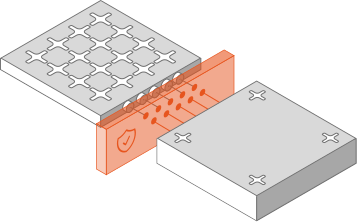
Keep event-driven systems loosely coupled.
Sportsbook, casino, payments and player activity generate a constant stream of events. CRM, safer gambling, fraud, loyalty and analytics all need different parts of them.
Orbital lets each consumer define the data it needs, without forcing producers to publish a schema that works for everyone.
A schema for each consumer
Send each system the fields and structure it needs, rather than making every consumer depend on the producer’s event format.
Enrich events as they flow
Combine event data with accounts, payments or other connected systems before it reaches the consumer.
Change producers without breaking consumers
When a provider changes its event schema, downstream systems can keep consuming the same contract.
Frequently asked questions
Got another gnarly question? We’d love to hear it. Come and chat on Slack.
Start with one integration.
Bring a provider API, safer-gambling workflow or regulatory report you already have. Add semantics to the schemas, and let Orbital build the integration.