Insurance
Orbital for Insurance
Connect policy, claims, billing, underwriting, broker and partner systems.
Orbital builds and maintains the integrations as your products, partners and platforms change.
Use cases
Integrate, simply.
Insurance workflows rarely stay in one system. Claims, underwriting and broker journeys span policy, billing, customer data and external providers.
Orbital works across those systems and builds the integration each workflow needs, on demand.
Get new distribution channels live faster
Brokers, marketplaces and embedded insurance partners each bring their own API contract and data requirements.
Tell Orbital what the fields in the partner contract mean. It works out how to fulfil them from policy, rating, customer and billing systems.
Change the claims flow as the process changes
Add a fraud check, repair partner or new digital claims step without wiring the whole journey together again.
Tag policy, claimant, coverage and loss data across the systems that hold it. Orbital plans the calls, joins and transformations each claims flow needs when it runs.
Reuse underwriting data across products
Claims history, customer records and external risk data already exist across your estate. Different products need different combinations of them.
Tell Orbital what the relevant fields mean — policyholder, claim amount, risk score and so on. Orbital can then assemble the combination each product needs, wherever the data lives.
Move books to the new core at your own pace
Keep legacy and new policy platforms running side by side while products and books move across at their own pace.
Channels keep working with the same policy and customer concepts. Orbital works out which system currently owns the data and routes each request there.
Reporting & Lineage
Trace every reported value back to its source.
Insurance reporting pulls data through policy, claims, finance and actuarial systems, often with calculations and transformations along the way.
When Orbital assembles report data, it captures provenance as it runs. Each reported value can be traced through the calls and transformations that produced it.
Field-level provenance
See where an individual reported value came from, not just which systems contributed to the report.
Track the transformations
See the joins, calculations and transformations applied between the source data and the final value.
Captured at runtime
Provenance is captured during execution, so it reflects the path the data actually took — not documentation that can fall out of date.
Keep policy and claims data in your estate.
Orbital runs inside your environment and routes data between systems without copying it into another data platform. It works with the identity and secret stores you already use.

Deploy in your cloud
Run Orbital inside your own cloud or network, so policyholder and claims data does not have to leave your environment.
Keep your data at home
Orbital routes data between your systems without copying it into a separate data platform or warehouse.
Bring your own identity
Integrate with any OIDC or SAML identity provider and keep the users and groups you already manage.
Keep your secrets
Connect Orbital to your preferred secret store, so credentials stay managed by the systems you already trust.
Define once. Enforce everywhere.
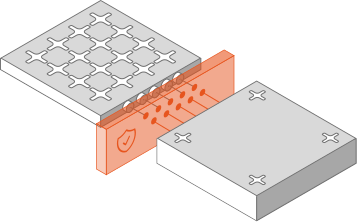
Control who can see or change policyholder, policy and claim data, down to individual fields, then apply the same rule across APIs, back-office tools and agents.
Policies can use live context — assigned adjuster, broker relationship, claim status or jurisdiction — when deciding what a caller can see or change.
Enterprise AI
Give agents capabilities, not microservices
Give agents access to policy, claims, customer and payment operations without exposing the service estate directly to the model.
Orbital works out which services to call and handles the orchestration deterministically. Identity, authorisation and sensitive-data controls are enforced before anything reaches the model.
Keep orchestration outside the LLM
The agent asks for the data or action it needs. Orbital works out which services to call and in what order.
Enforce security outside the LLM
Credentials stay in your secret store. Field-level authorisation and masking are applied before sensitive data reaches the LLM.
Audit what the agent touched
See which services were called, which fields were returned or changed, and which user or agent made the request.
Frequently asked questions
Got another gnarly question? We’d love to hear it. Come and chat on Slack.
Start with one workflow.
Bring a claims flow, broker API or underwriting integration you already have. Start with its existing schemas, and let Orbital work out the integration.